Loading...


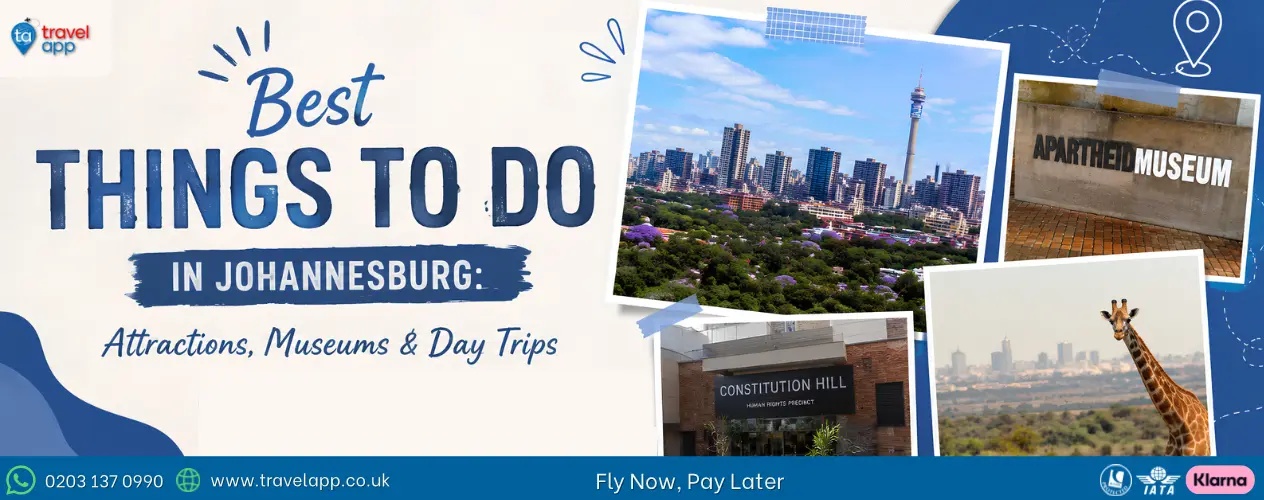
“Should I actually spend time in Johannesburg, or just fly through it on the way to Cape Town or the bush?”
That's a common question. Many UK travelers ask it while planning a trip to South Africa. The truth is, Johannesburg rewards those who plan well. The city has great things to do, not despite its history, but because it faces it openly. This guide highlights must-see attractions, honest safety tips, and practical planning for a successful Johannesburg trip.
Quick answer: Johannesburg's essential attractions are the Apartheid Museum, Constitution Hill, and Soweto (Vilakazi Street and Mandela House), alongside the creative Maboneng and Braamfontein neighbourhoods. Two to three days is enough to cover the highlights. It's best combined with a day trip to Pilanesberg or the Cradle of Humankind. Johannesburg has real safety risks, like most large cities its size. Sensible precautions like booking transport, not having valuables on display, and not walking unfamiliar areas after dark make it manageable and rewarding for prepared travellers.
Yes, treating Johannesburg as just a stopover on the way to Cape Town or Kruger misses its value. The city grew around a gold rush in 1886, earning the nickname “City of Gold” and the Zulu name eGoli. This history, rooted in migrant labor and mineral wealth, connects directly to apartheid and the struggle against it. Much of that history took place here.
Cape Town has its stunning coastline, winelands, and Table Mountain, and it rightly deserves its fame. Johannesburg, however, offers a different experience. It’s the best place to grasp modern South Africa, not just observe it.
You’ll find contemporary African art, a vibrant food and design scene, and neighborhoods revitalized by local entrepreneurs, all next to historical sites. Both cities are worth visiting for their unique reasons. This isn’t a competition; it’s about the trip you want.

Johannesburg's historical sites aren't background scenery. They're where apartheid was enforced, resisted, and eventually dismantled, and visiting them with that context makes the difference between sightseeing and actually understanding the city.

The Apartheid Museum is the single most important stop in Johannesburg for understanding how apartheid was built, enforced, and defeated. Visitors are randomly assigned a “white” or “non-white” entrance ticket on arrival, setting the tone for the exhibition. Open Tuesday to Sunday, 9am–5pm. From 1 May 2026, international and SADC tickets are R240 for adults and R190 for concessions; South African citizens pay R170 and R120. Allow around two hours. The content is graphic and not recommended for children under 11.
Constitution Hill was once a prison holding both common criminals and political prisoners, including Nelson Mandela and Mahatma Gandhi. Today it's home to South Africa's Constitutional Court. That shift, from prison to the seat of the country's highest court, is one of the more powerful things to see in the city. Open daily, 8:45am–5pm (last ticket 4pm). A one-hour highlights tour costs R150 for adults and R90 for children, students, and seniors. The fuller two-hour tour is R200, and the shorter is R110. Entry is free on six national holidays, including Human Rights Day and Freedom Day.

Soweto (South Western Townships) is where much of the anti-apartheid resistance was organised, and remains one of South Africa's largest and most historically significant residential areas. Vilakazi Street is the only street in the world to have housed two Nobel Peace Prize winners: Nelson Mandela and Archbishop Desmond Tutu. Mandela House, Mandela's former family home, still shows bullet holes and burn marks. Local and African Union visitors pay R105 for adults; international visitors pay R185, cashless only. A guided Soweto tour is worth the money; a good local guide adds context a self-guided walk can't.
A short walk from Vilakazi Street, the Hector Pieterson Memorial and Museum commemorates the 16 June 1976 Soweto Uprising, when students protesting enforced Afrikaans teaching were met with police gunfire. Hector Pieterson, aged 12, was among those killed, and a photograph of his death became one of the defining images of apartheid worldwide. Open Tuesday to Sunday; check current hours and admission before travelling, as these aren't consistently published.
Johannesburg isn't only a history lesson. The inner city has been steadily reclaimed by artists, designers, and independent business owners over the last fifteen years. That regeneration is as much a part of the city's story as its past.
Maboneng Precinct, on the eastern edge of the CBD, was one of the first of these projects, built around the Arts on Main complex and the Market on Main food market. It's walkable in daylight and dense with street art and independent cafes, a different side of the city from the historical sites. Braamfontein, near the University of the Witwatersrand, has a similar energy with more of a student and design-industry feel.
Braamfontein's best-known market has changed hands since most travel guides were last updated. The original Neighbourgoods Market closed for good in March 2020. Its Juta Street site now hosts The Playground, a successor market run by the same founder, every Saturday, 9am–6pm, with free entry before 11am. Worth knowing, since older guides still send readers to a market that no longer exists under that name. The Market Theatre in Newtown is worth checking too if you enjoy live performance. Open since 1976, it was one of the few spaces where multiracial audiences were tolerated under apartheid.
Johannesburg has more green space and family-friendly attractions than its skyline suggests. Several work well as a change of pace after a morning of museums.
The Walter Sisulu National Botanical Garden is built around a 70-metre waterfall and is home to a pair of resident Verreaux's eagles. It's one of the more peaceful things to do in Johannesburg. Entry is R60 for adults, free for pensioners on Tuesdays, and R35 for students. Suits most ages; easy half-day.
In Newtown, Sci-Bono is a hands-on science centre with 350-plus interactive exhibits, a planetarium, and robotics displays. Open Mon–Sat 9am–4:30pm, Sun 9am–3:30pm. Adult entry: R60, children (3–18): R40, family ticket (2+2): R180—a reliable rainy-day choice. Gold Reef City, built on a former gold mine and styled as a 19th-century mining town, combines a theme park with a mining museum. Open Thursday to Sunday, 9am–5pm; tickets are online-only, so buy ahead. It suits families and thrill-seekers more than a quiet couples' day.
Melville Koppies is the last preserved stretch of Johannesburg's original ridgeline, with evidence of human habitation going back 500,000 years. The main Central koppie opens only on Sundays, 8–11:30am (R100 adult); East and West sections are open daily, with the West best visited on a scheduled guided walk. Johannesburg Zoo, in Parktown, is a straightforward option for wildlife without leaving the city. It's rated more modestly by visitors than the botanical garden, though, so it shouldn't be your only wildlife stop.
If museums are your priority, here's how the main options compare on time, cost, and who they suit best.
| Museum | Best For | Time Needed | Area | Adult Price (approx.) |
| Apartheid Museum | History, first-time visitors | 2 hours | Southern suburbs | R170–R240 |
| Constitution Hill | History, architecture | 1–2 hours | Braamfontein/Hillbrow border | R150–R200 |
| Mandela House | Mandela's story, Soweto visits | 30–45 mins | Soweto (Vilakazi St) | R105–R185 |
| Hector Pieterson Museum | 1976 uprising, Soweto visits | 45–60 mins | Soweto | Check current pricing |
| Sci-Bono Discovery Centre | Families, science | 1–2 hours | Newtown | R60 |
Where you base yourself in Johannesburg shapes the whole trip. The city is spread out, and neighbourhoods vary a lot in character and safety profile. Most UK visitors are best served by Sandton or Rosebank. Melville and Maboneng are characterful alternatives for travellers who want a more local feel and are comfortable using booked transport.
| Area | Atmosphere | Best For | Practical Notes |
| Sandton | Polished, corporate, high-security | First-time visitors, business travellers | Gautrain station on site; safest and most convenient base, if less characterful |
| Rosebank | Smart, walkable shopping and dining precinct | Couples, comfort-focused travellers | Own Gautrain station; good restaurant scene within walking distance |
| Melville | Bohemian, café culture, low-rise streets | Couples, solo travellers wanting local character | Walkable in the day along 7th Street; use booked transport at night |
| Maboneng | Creative, gallery-and-market energy | Design and art lovers, younger travellers | Best visited by day; check current guidance before staying overnight |
Johannesburg's location in Gauteng puts several very different experiences within reach of a single day. Fossil sites, a genuine Big Five safari, and South Africa's capital city are all realistic options.
| Destination | Approx. Travel Time | Best For | Realistic as a Day Trip? |
| Cradle of Humankind (UNESCO World Heritage Site) | About 1 hour | Families, history and science | Yes Maropeng and Sterkfontein Caves combine well |
| Rhino and Lion Nature Reserve | 45 minutes–1 hour | Families short on time, self-drive to see wildlife | Yes, an easy half-day, extendable to a full day |
| Pilanesberg National Park | About 2.5 hours each way | A genuine Big Five safari experience | Yes, but long — expect a 14–16 hour door-to-door day |
| Pretoria | About 45 minutes–1 hour | Government architecture, Jacaranda-lined streets | Yes the Union Buildings and city centre suit a half or full day |
| Magaliesberg | About 1–1.5 hours | Scenery, hiking, hot air ballooning | Yes, best as a relaxed full day rather than a rushed half-day |
A word on Pilanesberg: it's a genuine Big Five reserve and malaria-free, which makes it unusually practical for a day trip, including with children. But a single day is, as one guide to the park put it, more like dipping your toes in than diving in. Sightings aren't guaranteed. If a proper safari is the main point of your South Africa trip, budget more than one day for it later in your itinerary.
| Traveller | Best Experiences |
| Families | Sci-Bono Discovery Centre, Gold Reef City, Walter Sisulu National Botanical Garden, Rhino and Lion Nature Reserve |
| Couples | Melville's café strip, Rosebank's restaurant scene, a guided Constitution Hill or Apartheid Museum visit, Magaliesberg for a slower day trip |
| Solo travellers | Guided Soweto and Apartheid Museum tours (both easy to join as a solo traveller), Maboneng by day, Rosebank or Sandton as a base |
| History lovers | Apartheid Museum, Constitution Hill, Hector Pieterson Museum, Mandela House, Cradle of Humankind |
| Food lovers | The Playground market in Braamfontein, Market on Main in Maboneng, Rosebank's restaurant strip |
| Adventure travellers | Pilanesberg game drives, Magaliesberg hiking and ballooning, Melville Koppies guided walks |
| Budget travellers | The Playground market (free before 11am), Melville Koppies East and West sections, Johannesburg Art Gallery, walking Rosebank and Melville by day |
Johannesburg doesn't have to be an expensive city to explore. Braamfontein's Saturday market is free to enter before 11am. Melville Koppies' East and West sections are open daily without the Central section's fee structure applying — check current rates directly, as these are periodically revised. Walking Melville's 7th Street or Rosebank's pedestrianised areas by day costs nothing beyond a coffee. Constitution Hill's outdoor precinct and gardens can be appreciated without joining a paid tour. Several public buildings, including Constitution Hill itself, also offer free entry on national holidays.
For most UK visitors, two to three days are sufficient to cover the essential historical sites, spend a few hours in one of the creative neighborhoods, and fit in a single day trip without feeling rushed.
If you only have a single day, prioritise the Apartheid Museum in the morning, when you're freshest for its content. Follow it with a guided afternoon in Soweto covering Vilakazi Street, Mandela House, and the Hector Pieterson Museum. These sites sit close together geographically and build on each other historically, so grouping them makes practical as well as narrative sense.
Day one follows the one-day plan above. Day two shifts to the city's present: a morning in Maboneng or Braamfontein, lunch at a local market, and an afternoon at Constitution Hill or the botanical garden, depending on your energy levels. Day three is a day trip. Choose the Cradle of Humankind to stay closer to the city, or Pilanesberg if a safari day matters more to your wider trip.
Johannesburg is not a city to visit casually, but it is a manageable one for prepared travellers. South Africa has a high crime rate, and Johannesburg is no exception. This isn't a myth to be dismissed, and no travel guide can honestly promise you'll be completely safe. What sensible planning can do is bring the risk down to a level most prepared travellers find acceptable.
The UK government's official travel advice for South Africa is worth reading in full before you travel. It specifically warns that criminals have followed travellers from OR Tambo Airport and robbed them en route arrange a pre-booked, reputable transfer rather than an unmarked taxi. The same advice covers carjacking risk at traffic lights and petrol stations, especially after dark, and recommends not resisting if targeted.
Book your transport in advance — Uber, a pre-arranged transfer, or the Gautrain — rather than hailing anything on the street.
Avoid walking in unfamiliar areas after dark, and be cautious about walking alone even by day outside well-frequented spots like Rosebank, Sandton, and Melville's main strip.
Don't display phones, cameras, or jewellery openly, especially at traffic lights or in crowded areas.
Use a hotel safe, keep valuables out of sight in the car, and avoid carrying your passport unless you need it.
For Soweto and the townships specifically, a reputable guided tour is safer, as well as more informative, than a self-guided visit.
None of this means treating every street as a threat. Sandton, Rosebank, and Melville's main café strip are used daily by residents and tourists alike without incident. Areas around the major museums are set up for visitors too. The realistic approach is the same one experienced travellers use in any large, unequal city: plan your transport, stay alert, and don't assume familiarity you don't have yet.
Johannesburg is not a walkable city the way London or Cape Town's City Bowl are. Its public transport isn't set up for casual tourist use the way a European city's might be. That doesn't mean you can't walk anywhere. It means walkability depends heavily on the specific neighbourhood, route, and time of day — worth checking rather than assuming.
The Gautrain is the standout option between OR Tambo Airport, Sandton, and Pretoria: fast, clean, and one of the more reliable ways to move around. Fares run roughly R20–R50, and the airport-to-Sandton leg takes around 12–15 minutes. It runs daily, 5:30am–8:30pm, though it doesn't reach every neighbourhood — Soweto, Maboneng, and Melville need a different option.
Uber and other rideshare apps are widely used in Johannesburg. They're generally considered safer than hailing a taxi on the street, since the driver and route are logged. That said, no app can guarantee complete safety; the usual precautions still apply: Check that the number plate matches, sit in the back, and share your trip with someone.
For sightseeing, the City Sightseeing hop-on hop-off bus covers 12 stops across two routes, roughly 9am–3pm. The Red Line takes in Constitution Hill, the Apartheid Museum, Gold Reef City, and the Johannesburg Zoo; the Green Line covers Rosebank. Check current pricing before you travel, as it varies by season and currency.
April to May and September to October offer Johannesburg's most comfortable weather, mild days between roughly 10 and 25°C, low rainfall, and good conditions for both sightseeing and day trips.
Summer (November to March) is warmer, up to around 30°C. January to March brings the most rain, often as short, sharp afternoon thunderstorms rather than all-day downpours. Winter (June to August) is dry and sunny during the day but cold at night, sometimes close to freezing. Pack layers if you're visiting then. Winter is also good timing for a Pilanesberg day trip, since the dry season pushes wildlife towards waterholes and makes sightings more likely.
This isn't a competition with one winner; the two cities suit different priorities, and many UK itineraries include both.
| Category | Johannesburg | Cape Town | Verdict |
| History | The centre of South Africa's apartheid and liberation story | Present, but less central to the national narrative | Johannesburg, for history-focused travellers |
| Culture & art | Strong contemporary art and design scene (Maboneng, Braamfontein) | Strong too, with a more polished gallery and festival scene | Roughly even — different flavours |
| Beaches & coastline | None — landlocked | Excellent beaches and coastal scenery | Cape Town, clearly |
| Wildlife access | Pilanesberg (2.5 hrs) and Kruger further afield | Further from major Big Five reserves | Johannesburg, for safari day-trip ease |
| Nightlife | Growing but less internationally known | More established bar and nightlife scene | Cape Town, slightly |
| Nature & scenery | Magaliesberg, botanical gardens | Table Mountain, winelands, dramatic coastline | Cape Town, for scenery |
| Family activities | Sci-Bono, Gold Reef City, Rhino and Lion Reserve | Aquarium, beaches, Table Mountain cable car | Roughly even |
| First-time visitors | Rewards those who plan ahead and book guided experiences | Generally easier to navigate independently | Cape Town, for a lower-effort first trip |
For an easier, more postcard-friendly introduction, Cape Town is the safer choice. Johannesburg is worth the extra effort if you want to understand South Africa's recent history and creative present, and you're willing to plan transport and guides properly. The two combine well if your itinerary allows for both.
UK citizens can visit South Africa without a visa for up to 90 days for tourism. Your passport needs to be valid for at least 30 days after you leave, with two blank pages. Confirm the specifics against the UK government's South Africa entry requirements before you book.
Once your documents and dates are sorted, Travelapp UK's South Africa holiday packages bring flights and accommodation together in one booking. If you're weighing Johannesburg against a coastal add-on, our Holiday packages are worth comparing side by side. For flights specifically, our flight comparison tool tracks fares across the main routes into OR Tambo.
However you decide to plan it, Johannesburg rewards travellers who take it seriously rather than skip through it. If you'd like help putting flights, a South Africa package or a Cape Town add-on together, get in touch with Travelapp UK. We'll help you build an itinerary that fits how you want to experience the City of Gold.
Quick answers to common questions. Reach out if you need more help.
Yes. It's the centre of South Africa's apartheid and liberation history and home to a creative contemporary art and food scene. Plan transport and guided experiences properly, rather than treating it as a casual walking city.
Its 1886 gold rush origins (hence “City of Gold"); its central role in apartheid and its end; Nelson Mandela's former home on Vilakazi Street; and a growing reputation for contemporary African art and urban regeneration in neighbourhoods like Maboneng and Braamfontein.
It's manageable for prepared travellers, not a city to visit casually. South Africa has a high crime rate, and Johannesburg is no exception. Booked transport, avoiding unfamiliar areas after dark, and guided Soweto tours bring the risk down to a level most prepared travellers accept.
Two to three days covers the essential history sites, a creative neighbourhood, and one day trip without feeling rushed. One day is workable if you focus on the Apartheid Museum and a guided Soweto tour.
The Apartheid Museum, Constitution Hill, Soweto (Vilakazi Street, Mandela House, the Hector Pieterson Museum), and the Maboneng and Braamfontein neighbourhoods for a look at the city's creative present.
The Apartheid Museum for depth and scale, Constitution Hill for its architecture and legal history, and Mandela House and the Hector Pieterson Museum for a closer, personal view of the same period.
Yes. Pilanesberg National Park, about 2.5 hours away, is a malaria-free Big Five reserve that works as a long day trip. The closer Rhino and Lion Nature Reserve, 45 minutes to an hour away, is a good option if you're short on time.
The Cradle of Humankind (around an hour away), the Rhino and Lion Nature Reserve (45 minutes to an hour), Pilanesberg National Park (about 2.5 hours), Pretoria (45 minutes to an hour), and the Magaliesberg (around 1 to 1.5 hours).
Not in the way London or central Cape Town are. Walkability depends heavily on the specific neighbourhood and time of day. Rosebank, Sandton and Melville's main strip are fine to walk by day, but booked transport is the safer default elsewhere and after dark.
April, May, September and October offer the mildest weather, with temperatures around 10–25°C and low rainfall. Winter (June–August) is dry and good for wildlife spotting on a Pilanesberg day trip but cold at night.
Yes, with planning. Sci-Bono Discovery Centre, Gold Reef City, Walter Sisulu National Botanical Garden, and the Rhino and Lion Nature Reserve are all family-friendly. The Apartheid Museum's content, though, isn't recommended for children under 11.
Neither is objectively better — they suit different priorities. Johannesburg offers deeper history and easier safari day trips; Cape Town offers beaches, scenery, and an easier first-time experience. Many UK itineraries include both.
The Playground market in Braamfontein before 11am, walking Melville's 7th Street or Rosebank's pedestrianised areas by day, and Constitution Hill's outdoor precinct.
Sandton or Rosebank for convenience and safety, especially for first-time visitors; Melville for a more local, café-culture feel if you're comfortable using booked transport at night.
It carries real risks, as confirmed by the UK government's travel advice. Even so, hundreds of thousands of British tourists visit safely every year by following standard precautions: booked transport, discretion with valuables, and caution after dark.