
Loading...


Landing in Makkah for the first time is one thing. Arriving there with spiritual readiness is another. For many UK Muslims planning their Umrah, the steps are easy to remember. A successful trip needs one key thing: the right mindset before you fly.
Umrah, in short, is the “lesser pilgrimage” to the Holy Kaabah in Makkah.
Umrah is different from Hajj. Hajj is required once in a lifetime and has set dates in the Islamic month of Dhul Hijjah. In contrast, Umrah is voluntary and can be done any time of the year. That flexibility may help explain its popularity with British Muslims seeking a shorter, more personal act of worship. The Ministry of Hajj and Umrah's most recent report recorded a 94% pilgrim satisfaction rate for the season, alongside a service quality index above 92%.
This guide breaks the process down into simple, clear steps, following the Sunnah of the Prophet Muhammad (peace be upon him), so you can focus on the experience rather than worrying about what comes next. Once you've got the religious side straight, TravelApp is here to help with the practical part: flights, visas and accommodation near the Haram.
Umrah means visiting the Kaabah in Makkah to do specific rituals: Ihram, Tawaf, Sa'i, and Halq or Taqsir. It's called the "minor pilgrimage" because it isn't one of the five pillars of Islam and has no set dates. You can perform Umrah almost any time of the year. Ramadan is especially popular. An Umrah during this month is believed to bring the reward of a Hajj with the Prophet (peace be upon him).
The main difference between Umrah and Hajj is size and timing. Hajj must be done during a specific time in the Islamic month of Dhul Hijjah. It includes extra rituals like standing at Arafah and is required once in a lifetime for those who can. Umrah is shorter, simpler, and voluntary, which is why many UK Muslims choose to perform it more than once.
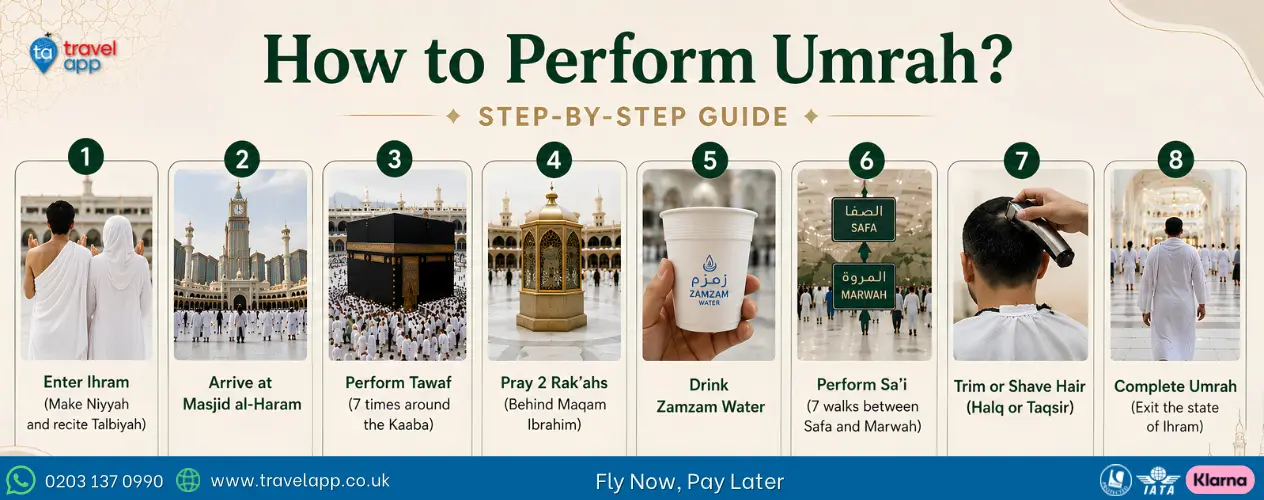
There are seven key steps to perform Umrah. Most Islamic schools, like Hanafi, Shafi'i, Maliki, and Hanbali, agree on these essentials. However, small details may vary.
Ihram is the sacred state every pilgrim enters before starting Umrah. For UK pilgrims, this often begins in an unusual place: mid-air.
Before you reach the miqat, the boundary that marks the start of the sacred zone around Makkah, do a few things. First, perform ghusl, trim your nails, and apply light perfume to your body, not your clothes. Men wear two simple white sheets, the izar and rida. Women dress in their normal, modest clothing in any color. Once you're dressed, pray two rak'ahs if you can. Then, make your niyyah, or intention, for Umrah.
Pro tip for UK pilgrims: Most direct flights from the UK to Jeddah or Madinah cross the miqat while still in the air. Airlines usually announce this. It’s smart to change into Ihram at the airport or be ready to do so in the plane's restroom. Avoid a rushed change at 30,000 feet.
As soon as you're in Ihram, begin reciting the Talbiyah: “Labbayk Allahumma labbayk, labbayka la sharika laka labbayk...” Men recite it aloud, women quietly, and you continue until you begin Tawaf.
As soon as you enter Ihram, begin reciting the Talbiyah:
“Labbayk Allahumma labbayk, labbayka la sharika laka labbayk, innal hamda wan-ni'mata laka wal-mulk, la sharika lak.”
(“Here I am, O Allah, here I am. Here I am, You have no partner, here I am. Verily all praise, blessing and sovereignty belong to You. You have no partner.”)
Men recite this aloud; women recite it quietly enough that only those nearby can hear. Keep repeating it during your journey to Makkah, and continue until you begin Tawaf.
Tawaf is the heart of Umrah: seven circuits of the Kaabah, performed on foot within the Masjid al-Haram.
Every circuit moves anti-clockwise, with the Kaabah kept on your left shoulder throughout.
Begin, if you can reach it, by touching or kissing the Black Stone (Al-Hajar al-Aswad), a gesture known as Istilam. If the crowds make that impossible, simply face the stone, raise a hand, and say “Bismillah, Allahu Akbar” as you pass it on each of the seven laps.
Saudi Arabia has invested more than $1.3 billion in holy site infrastructure in recent years.This includes tens of thousands of new air-conditioning units and washroom facilities. With nearly 17 million foreign Umrah pilgrims expected in 2024, the flow around the Kaabah is much improved. But be ready for a dense, moving crowd. Remember your wudu: if it breaks, step aside, renew it, and then rejoin where you left off.
Finish your seventh circuit. Then, pray two rak'ahs behind Maqam Ibrahim if there's space. If it’s too crowded, find a spot anywhere else in the mosque.
After Tawaf, pray two short rakats near Maqam Ibrahim (the Station of Abraham), if there’s space. If it's too crowded, you can pray anywhere else in the mosque. This prayer is Sunnah, meaning it’s recommended but not required. Your Umrah is still valid even if you pray farther away.
Before moving on to Sa'i, drink Zamzam water, which is available throughout the Haram. There's no fixed ritual here beyond drinking with gratitude; many pilgrims make a personal dua while doing so, following the tradition that Zamzam water is drunk “for whatever intention it is drunk for.”
From Tawaf, walk to the base of Mount Safa to start Sa'i. This involves seven laps between Safa and Marwa, following the steps as described.
At Safa, face the Kaabah. Raise your hands and recite the takbir. You can also say your personal duas before heading to Marwa. Each trip one way counts as a lap. You’ll return to Safa, breathless, after your seventh trip. Men should walk briskly along a short stretch marked by green lights, while women can walk at a normal pace.
Note: Sa'i is more than just walking. It honors Hajar (peace be upon her) as she ran between these hills, searching for water for her son Ismail. This was before the Zamzam well appeared. Each lap reflects her journey, making the ritual feel more meaningful.
The final act of Umrah is cutting the hair, and it's simpler than most first-timers expect.
Men choose between Halq, shaving the head completely, or Taqsir, trimming it evenly all over. Both are valid, though tradition favours Halq:
“O Allah, have mercy on those who shave their heads.” — a supplication the Prophet (peace be upon him) is reported to have repeated three times for those who shaved, and once for those who merely trimmed.
Women do not shave their heads; trimming a fingertip's length from the ends of the hair is sufficient. The moment you complete this, the restrictions of Ihram lift, and you finish Umrah.
Many UK pilgrims then travel on to Madinah, and it's worth building time in for it. More than 10 million worshippers prayed in Al-Rawdah Al-Sharifah, the sacred area between the Prophet's pulpit and grave, in 2024 alone, and most now book their slot through the Nusuk app in advance. It's a fittingly reflective way to close out the journey.
Umrah doesn't need you to memorize many set prayers. The Talbiyah is the main recitation you'll repeat often before Tawaf. After that, most of your worship is personal dua in any language you prefer.
If you want to wish someone well during Umrah, say “Umrah Mabroorah” (may your Umrah be accepted). It's a simple and warm way to acknowledge their journey.
The rituals, from entering Ihram to Halq or Taqsir, take about three to five hours. This depends on how busy the Haram is during your visit. Most pilgrims book longer trips. A first visit usually lasts 5 to 7 days. If you want to visit Madinah, aim for 10 days or more.
A 7-day Umrah package from the UK costs between £1,000 and £1,500 per person. Prices vary by season, hotel quality, and the distance to the Haram. During Ramadan and school holidays, costs rise sharply. If you're on a budget, consider traveling in quieter months like Muharram or Safar.
TravelApp's Umrah packages shows current pricing and instalment options if you want an up-to-date figure.
Most of the process is the same for men and women, but a few differences are important to know.
Clothing is the main difference. Women don’t need a special uniform for Ihram. They can wear any loose, modest clothing in any color, as long as it covers the body well. The only real restriction is on the face and hands: a fitted niqab or gloves should not be worn in Ihram. However, a loose headscarf can cover the face from unrelated men if needed.
Hair is another difference. At the end of Umrah, women trim a small amount of hair, about fingertip length. Men, on the other hand, shave their heads.
Menstruation is often a worry for first-timers, but it doesn’t need to be. A woman who is menstruating can still enter Ihram, travel, and take part in almost every part of Umrah as usual.
The one ritual she pauses for is Tawaf around the Kaabah; she waits until her period ends and she has performed ghusl, then completes Tawaf and the remaining steps as usual. If your period starts partway through your trip, your TravelApp travel companions or group leader can help you plan around it so you don't feel rushed.
Here's a short checklist to get you started:
Your passport and visa documents
Ihram clothing (two sets for men, in case one needs washing)
Comfortable slip-on sandals for trips in and out of the mosque
A money belt
A small prayer mat
Unscented toiletries (perfumed products aren’t allowed in Ihram)
Any regular medication in its original packaging
Also, pack light layers. The air conditioning in Haram can be chilly, even when it's hot outside. We’ll soon publish a full Umrah packing list for men, women, and families.
Once you're confident on the religious side, the practical side comes down to three things: flights, accommodation and, if you'd rather not arrange everything separately, a package that bundles them together.
TravelApp's Umrah packages include flights, visa processing, transfers and hotels close to the Haram in Makkah and Madinah, with instalment options if you'd rather spread the cost. If you're booking flights and accommodation separately, we also list direct and connecting flights to Jeddah, the main gateway airport for pilgrims heading to Makkah. Whichever route you choose, our team can talk you through visa requirements and timing before you book.
Preparing for Umrah can feel overwhelming, especially for newcomers. The rituals are simple once you understand them: Ihram, Talbiyah, Tawaf, two rakat, Zamzam, Sa'i, and Halq or Taqsir. The key is to give yourself ample time to worship without rushing. This helps you appreciate the experience.
When you're set for details, TravelApp's Umrah packages include flights, visas, transfers, and hotels close to the Haram. We also offer installment options to help with costs.
Take a look at our current packages, or get in touch and we'll help you plan a trip that fits your budget and your dates.
Quick answers to common questions. Reach out if you need more help.
Ihram (intention and sacred clothing), then reciting the Talbiyah. Next, Tawaf (seven circuits around the Kaabah) comes. After that, you pray two rakat at Maqam Ibrahim. Drink Zamzam water, then perform Sa'i (seven trips between Safa and Marwa). Finally, finish with Halq or Taqsir (shaving or trimming the hair).
After entering Ihram at the miqat, your first stop in Makkah is the Masjid al-Haram to begin Tawaf around the Kaabah. Everything else, including Sa'i, follows from there.
No, it's Sunnah, which means it's highly recommended. The Prophet (peace be upon him) prayed it often. However, your Umrah is still valid if you pray it away from Maqam Ibrahim or skip it due to real difficulty.
While in Ihram, spouses should avoid intimacy and anything that might lead to it. This includes kissing and flirtatious behavior until Umrah is complete. Ordinary contact, like holding hands, is usually fine. If you're unsure, it's best to consult a knowledgeable scholar before you travel.
The traditional greeting is “Umrah Mabroorah”, meaning “may your Umrah be accepted.” It's the same well-wish used for Hajj and a nice thing to say to a friend or family member before they set off.
In addition to your package, flight, and hotel costs, budget for your visa, local transport, meals, and some spending money for gifts. Many UK pilgrims set aside an extra £200 to £400 beyond their package price. This amount can vary based on trip length and personal spending habits.
Yes. The rituals take just a few hours. A 5 to 7 day trip lets you perform Umrah, rest, and explore Makkah. You'll also have a day or two free in case you need extra time for flights or visas.
Prices are usually lowest outside Ramadan, school holidays and the Hajj season. Months like Muharram and Safar tend to see quieter crowds and better prices on flights and hotels.




