Loading...


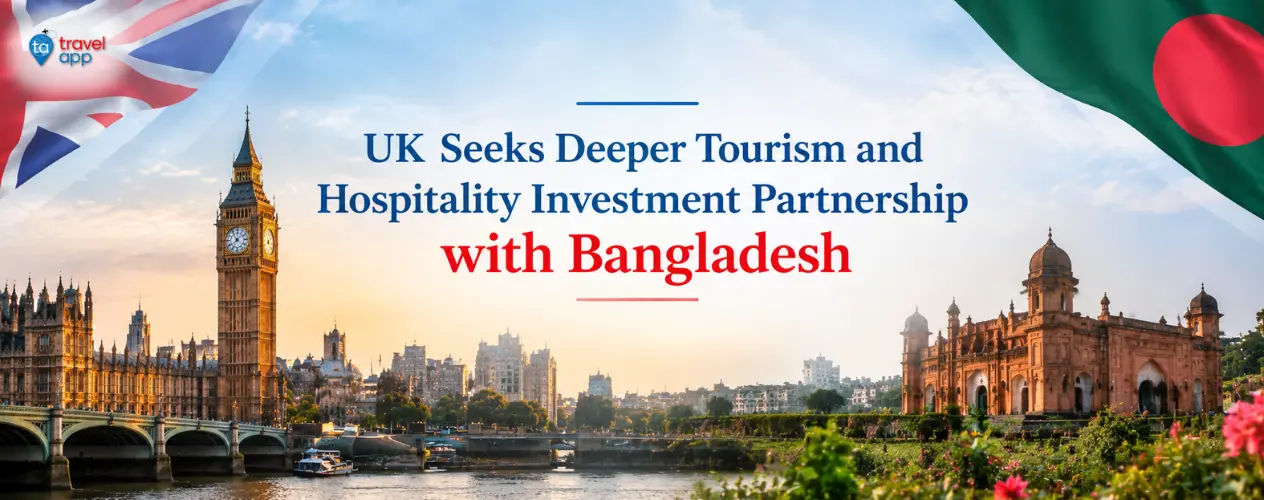
The UK says it wants to play a bigger role in Bangladesh's tourism sector by encouraging investment, strengthening commercial partnerships and bringing businesses and institutions together.
British High Commissioner to Bangladesh Sarah Cooke made the comments at a World Tourism Day reception hosted by the British High Commission in Dhaka on 29 September.
The event brought together Bangladesh's Civil Aviation and Tourism Minister M. Rashiduzzaman Millat, government representatives and leaders from the aviation, tourism and hospitality sectors to discuss opportunities for further investment in Bangladesh.
Cooke said Bangladesh has "enormous tourism potential" and highlighted the country's culture, heritage, natural beauty and hospitality. She pointed to the tea gardens of Sylhet, the beaches of Cox's Bazar and the country's heritage sites as examples of what could attract more international visitors.
She said the UK wants to support tourism by encouraging investment and commercial partnerships that can create long-term economic value for both countries.
The discussion went beyond hotels and holiday destinations.
Cooke said tourism and hospitality should be recognised as an important part of Bangladesh's future economic growth, alongside manufacturing, infrastructure and financial services.
She also linked tourism closely with aviation. A visitor's experience, she said, begins when they book a flight and continues through the airport and immigration process.
UK aviation interests in Bangladesh were also discussed earlier in September. At a meeting on 15 September, Cooke and Minister Millat discussed Bangladesh's process of buying Airbus aircraft to modernise Biman Bangladesh Airlines' fleet. They also discussed UK-based Menzies Aviation's interest in ground-handling services at Dhaka's new Third Terminal.
Menzies has said it would invest more than US$12 million in its first year and create over 1,000 jobs in Bangladesh if it wins the licence. Bangladesh's Civil Aviation Authority plans to appoint a second ground-handling operator alongside Biman, and several international companies are competing.
These are proposals rather than confirmed projects.
The World Tourism Day reception also highlighted existing investment in Bangladesh's tourism sector.
According to the British High Commission, more than US$250 million has been invested in Mana Bay, a British-backed tourism development that includes the Mana Bay Water Park and a recently soft-launched 95-room resort.
UK-headquartered InterContinental Hotels Group (IHG) also has its Southwest Asia area office in Bangladesh. IHG's regional leadership has said the company sees potential for stronger tourism links between Bangladesh and the UK.
These examples show existing commercial activity. The wider impact on Bangladesh's tourism market will depend on how further investment develops.
For travellers from the UK, one of the most significant developments is the new Third Terminal at Hazrat Shahjalal International Airport in Dhaka.
Minister Millat said on 8 September that the terminal was expected to partially open on 16 December 2026, initially handling around 20 flights. Flights will increase gradually, with full operations expected by March or April 2027. The terminal will eventually be able to handle around 200 flights.
The terminal was first inaugurated in October 2023 but has not yet opened to passengers, after repeated delays over equipment, funding and operating arrangements. Travellers should check the latest information before planning a journey around its opening.
The UK is already an important travel market for Bangladesh, particularly for British Bangladeshis visiting family and friends.
Biman Bangladesh Airlines operates direct services from London Heathrow to Dhaka and Sylhet, as well as from Manchester to Sylhet. Other airlines offer one-stop options between the UK and Bangladesh through major Middle Eastern hubs.
If further tourism and aviation investment goes ahead, UK travellers could eventually see:
More modern airport facilities: Dhaka's Third Terminal is designed to expand capacity and modernise check-in, immigration and baggage handling once it is fully operational.
More international hotel options: further investment from international hospitality companies could widen accommodation choices.
Greater visibility for destinations outside Dhaka: Sylhet and Cox's Bazar were highlighted as part of Bangladesh's wider tourism potential.
Stronger aviation links: fleet modernisation at Biman and new ground-handling competition at Dhaka could improve the travel experience if the plans go ahead.
These are potential longer-term effects, not changes travellers should expect immediately.
The UK has not announced a new tourism programme or funding package as a result of the World Tourism Day reception. Instead, Cooke's comments point to an interest in encouraging investment, commercial partnerships and international expertise.
The next stage will depend on individual projects and partnerships, including proposed aviation investments and the continued development of Bangladesh's tourism and hospitality sector.
The British High Commission said the UK would continue supporting Bangladesh's economic development and international connectivity through investment, commercial partnerships and UK Export Finance.
For travellers, the most immediate development to watch is Dhaka's Third Terminal and its planned phased opening.
Before travelling, check the latest UK government travel advice for Bangladesh, including current entry and visa requirements.
For the latest news, information, and travel hacks, read Travelapp Blogs.