
Loading...


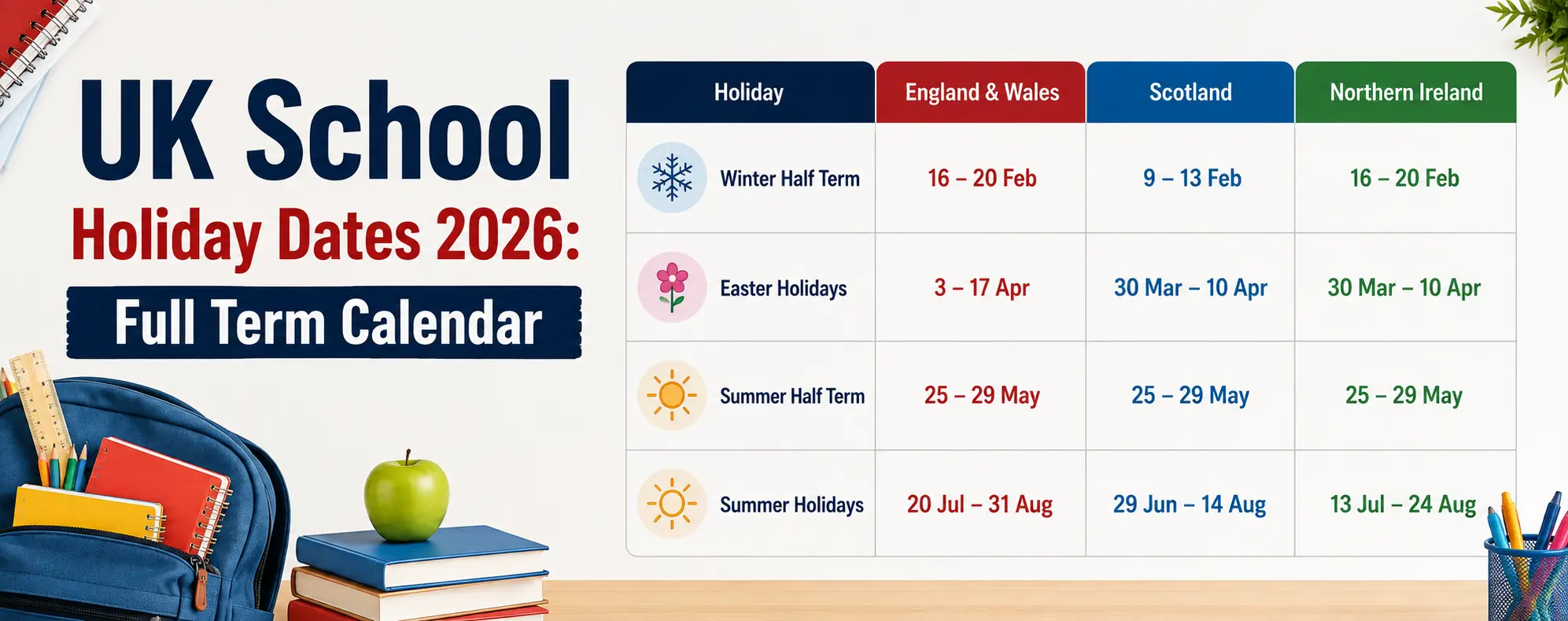
UK school holidays in 2026 vary between England, Scotland, Wales and Northern Ireland. Dates can also differ by local authority or individual school. The main breaks are February half term, Easter, May half term, summer, October half term and Christmas. The table below shows the pattern most schools follow. Then check your own school or council for the exact dates that apply to your child.
| Holiday | England* | Scotland* | Wales | N. Ireland |
| February half term | 16–20 Feb | Early–mid Feb | 16–20 Feb | 12–13 Feb |
| Easter holidays | Late Mar–mid Apr | Early–mid Apr | 30 Mar–10 Apr | 2–10 Apr |
| May half term | 25–29 May | No set week** | 25–29 May | No set week** |
| Summer holidays start | Mid–late Jul | Late Jun | 21 Jul | 1 Jul |
| October half term | 26–30 Oct | Mid Oct | 26–30 Oct | 29–30 Oct |
| Christmas holidays start | 21 Dec | 21 Dec | 18 Dec | 21 Dec |
*England and Scotland have no single national calendar. Each local authority sets its own dates. These are the pattern many (not all) areas follow see the sections below for real examples of how much they can differ. Wales and Northern Ireland dates are set centrally and apply more consistently. **Scotland and Northern Ireland don't have a fixed May half-term week. Instead, most areas take single days off around the early and late May bank holidays.
England has no national school holiday calendar. Each local authority sets its own term dates. Academies and free schools can set their own calendar too, independent of their council. Many areas follow a similar pattern; Essex, for example, matches the dates above almost exactly. But real gaps exist. Durham's February half term runs 20 Feb–2 Mar 2026, a full week later than Essex's 16–20 Feb. Durham's Easter break also runs into late April, while Essex breaks up in late March. Always check GOV.UK's term date finder or your school's own website for your specific dates.
Scotland works the same way as England. Each of its 32 local authorities sets its own term dates, confirmed by Education Scotland's Parentzone. There's no single national calendar. Timing can vary more between Scottish council areas than almost anywhere else in the UK. South Lanarkshire's October break, for instance, runs a full week (12–16 Oct 2026), while neighbouring councils sometimes take a different week entirely. Scotland also doesn't have a dedicated May half-term. Most areas instead take single local holidays around the early and late May bank holidays. Terms typically start in mid-to-late August, earlier than the rest of the UK.
Wales is different. The Welsh Government sets school term dates nationally. Cardiff, Swansea, Carmarthenshire and almost every other Welsh local authority follow the same calendar, shown in the table above. Individual schools still set their own INSET (training) days locally, so those can differ school to school even though the main holiday dates don't.
Northern Ireland's dates are set centrally by the Education Authority. Most grant-aided schools follow them, giving more consistency than England or Scotland. One distinctive feature: NI's February half term is typically just two days rather than a full week. Dates can still vary slightly by school type, so it's worth confirming with your child's school before booking.
A bank holiday doesn't automatically mean school is closed for the week. The early May bank holiday (Monday 4 May 2026) falls in normal term time for most schools. Children get that Monday off, then it's back to school as usual. The spring bank holiday (Monday 25 May 2026) does fall within May half term for many areas this year. That's a coincidence of the calendar, though, not a rule you can rely on every year.
INSET days (In-Service Training days) are extra days when schools close to pupils so staff can train. Every school sets its own INSET days, so two schools on the same street can have different ones, and they aren't listed in council-wide holiday calendars. They're usually placed next to an existing holiday, which can turn a one-week break into 9 or 10 days off. Always check your own child's school calendar, since this is the detail most UK-wide date lists miss entirely.
Flights and package prices rise during school holidays because demand is concentrated into the same few weeks. Summer and the Christmas fortnight see the biggest increases; October and February half terms see smaller but real rises too. Exactly how much more you'll pay depends on your destination, dates and how far ahead you book, so there's no fixed percentage that applies everywhere.
Book early for summer 2026 and Christmas. The best-value family rooms and direct flights sell out first, not just get pricier. For half terms, February and October are typically calmer and cheaper than May or summer. Flying from a regional airport, choosing a midweek departure, or picking a package deal over separately-booked flights and hotels can all help stretch your budget. If your school allows flexibility around an INSET day, that extra day can sometimes help you avoid the very peak fare dates. Check with the school first, though, since term-time absence outside agreed INSET days has its own rules.
Once you know your dates, Travelapp can help with the next step. Browse flights, compare holiday packages including our Turkey packages, and book early for the best choice during peak school holiday weeks.
Quick answers to common questions. Reach out if you need more help.
The main breaks are February half term, Easter, May half term, summer, October half term and Christmas. Exact dates vary by nation and, in England and Scotland, by local authority—see the table above for the typical pattern.
Most of England and Wales break up 16–20 February 2026. Scotland and Northern Ireland dates differ by council and area; Northern Ireland's break is typically just two days (12–13 Feb).
Most English and Welsh schools break up in late March, returning in mid-April, though this varies more than any other holiday by council — some areas break up as much as two weeks later than others.
Most of England and Wales take 25–29 May 2026. Scotland and Northern Ireland don't have a fixed May half-term week; they typically take single days off around the early and late May bank holidays instead.
Most English schools break up in mid-to-late July and return in early September. Scotland breaks up earliest, in late June, and Northern Ireland from around 1 July.
Most of England and Wales take 26–30 October 2026. Scottish dates vary more by council, and Northern Ireland's break is typically shorter, around 29–30 October.
No. Wales and Northern Ireland set their dates centrally, so they're consistent nationwide. England and Scotland don't have a national calendar — each local authority sets its own dates, so timing can genuinely differ by a week or more between areas.
Yes, in England and Scotland. Durham's February half term 2026, for example, falls a full week later than Essex's. Always check your own local authority or school rather than assuming a UK-wide date applies to you.
Staff training days set individually by each school, when pupils don't attend. They're not part of the standard council holiday calendar and can add extra days off next to an existing break, so check your child's own school calendar.
Generally, yes, especially in summer and over Christmas, because demand is concentrated into the same weeks. The exact increase depends on your destination and how far ahead you book, so there's no single fixed figure.




