
Loading...


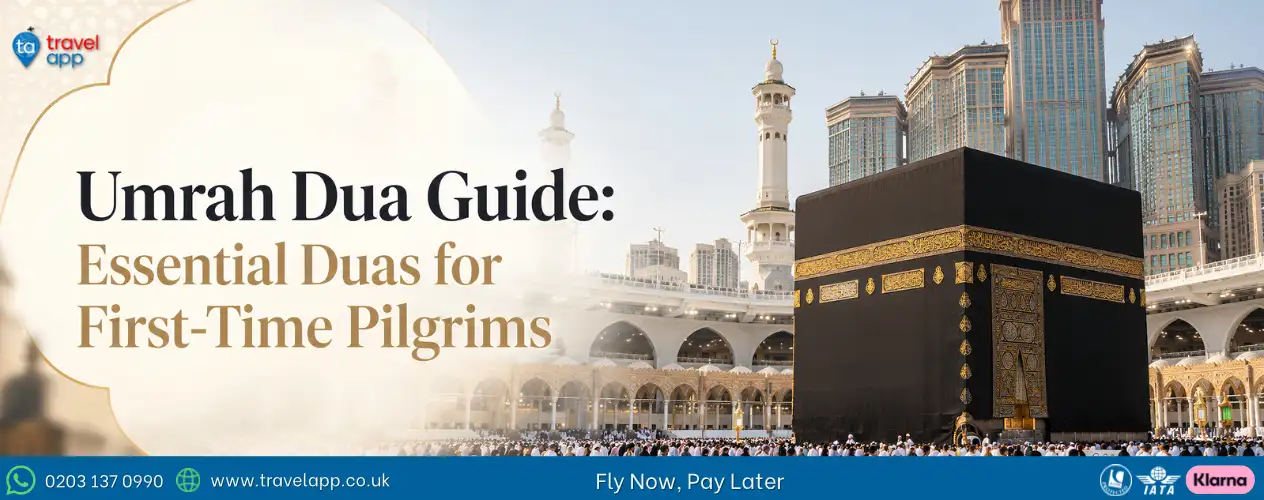
Preparing for your first Umrah can feel like a lot at once. You might feel excited, emotional, and a little worried too. Many first-time pilgrims ask the same question: what if I forget a dua, or say the wrong words?
The short answer: you do not need to memorise a long list of prescribed duas to perform a valid, meaningful Umrah. A small number of supplications are authentically reported from the Prophet Muhammad (peace be upon him). Beyond those, your own sincere dua, in whatever words come from your heart, is encouraged, not just acceptable.
This Umrah dua guide walks through each stage of the journey: entering Ihram, the Talbiyah, entering Masjid al-Haram, Tawaf, Hajar al-Aswad, Rukn al-Yamani, Maqam Ibrahim, Zamzam, Safa and Marwa, and personal supplication. Every specific dua included here is checked against the Qur'an or an authentic hadith source, with the reference given so you can see where it comes from.
We will also correct a common misunderstanding early on: there is no authentically reported specific dua for each of the seven rounds of Tawaf. More on that below.
The niyyah for Umrah is the intention you make in your heart to perform Umrah for the sake of Allah. It does not require a fixed Arabic formula.
Many pilgrims say a phrase such as "Labbayk Allahumma Umrah" (Here I am, O Allah, for Umrah) when starting. This is a common verbal expression of intention, not a mandatory scripted dua. The intention itself is a decision of the heart. Saying it aloud is simply a common practice, not an obligation reported from the Prophet as a fixed wording.
Before you reach this point, it is worth having the practical side settled too, so nothing is left unresolved once you enter the state of Ihram. Confirm your travel documents are in order, and check the current position on our Saudi Arabia ETA guide for entry requirements.
The Talbiyah is the declaration pilgrims recite after entering Ihram and beginning their Umrah. It is one of the most well-documented parts of the journey, reported in Sahih Muslim (1184) from Ibn Umar.
Arabic:
لَبَّيْكَ اللَّهُمَّ لَبَّيْكَ، لَبَّيْكَ لَا شَرِيكَ لَكَ لَبَّيْكَ، إِنَّ الْحَمْدَ وَالنِّعْمَةَ لَكَ وَالْمُلْكَ، لَا شَرِيكَ لَكَ
Transliteration:
Labbayk Allahumma labbayk, labbayk la sharika laka labbayk, innal hamda wan-ni'mata laka wal-mulk, la sharika lak.
Meaning:
Here I am, O Allah, here I am. Here I am, You have no partner, here I am. Verily all praise, grace and sovereignty belong to You. You have no partner.
Say the Talbiyah after entering the state of Ihram, and repeat it frequently on the way to Makkah. Stop reciting it once you begin Tawaf.
Arriving at Masjid al-Haram for the first time is an emotional moment for many pilgrims. Take a breath. There is no rush, and no single required way to react.
What is the dua for entering the mosque? It is a short supplication asking Allah to open the doors of His mercy, reported in Sahih Muslim (713).
Arabic:
اللَّهُمَّ افْتَحْ لِي أَبْوَابَ رَحْمَتِكَ
Transliteration:
Allahumma iftah li abwaba rahmatik.
Meaning:
O Allah, open the gates of Your mercy for me.
This is the general dua for entering any mosque, including Masjid al-Haram. Say it as you step inside, before you begin Tawaf.
Tawaf is walking around the Ka'bah seven times, starting and ending at the Black Stone (Hajar al-Aswad). This section covers what is established in the sources, and what is commonly assumed but not required.
Begin each round from the corner of the Black Stone. If you can reach it safely, you may touch or kiss it, following the example of the Prophet. If you cannot, you may point towards it and say the takbir, based on the practice of Ibn Umar reported in Sahih al-Bukhari (1613).
Arabic: اللَّهُ أَكْبَرُ (Allahu akbar)
Meaning: Allah is the Greatest.
You do not need to push, rush or cause harm to anyone to reach it. Umar ibn al-Khattab, a companion of the Prophet, said at the Black Stone: "I know you are a stone that can neither benefit nor harm. Had I not seen the Messenger of Allah kiss you, I would not have kissed you" (Sahih al-Bukhari, 1597). Touching it is a Sunnah act of following the Prophet's example. It has no power of its own, and your Tawaf is complete and valid without it.
As you walk, you may recite Qur'an, make dhikr (remembrance of Allah), or offer personal dua in any language. There is no single fixed text you must recite while walking between the corners.
Rukn al-Yamani is the corner of the Ka'bah before the Black Stone, in the direction you are walking. Between Rukn al-Yamani and the Black Stone, many pilgrims recite a dua that also appears in the Qur'an (Surah al-Baqarah, 2:201). Its recitation at this point in Tawaf is reported from Abdullah ibn as-Sa'ib in Sunan Abu Dawud (1892), graded sound by the hadith scholar al-Albani.
Arabic:
رَبَّنَا آتِنَا فِي الدُّنْيَا حَسَنَةً وَفِي الْآخِرَةِ حَسَنَةً وَقِنَا عَذَابَ النَّارِ
Transliteration:
Rabbana atina fid-dunya hasanatan wa fil-akhirati hasanatan wa qina 'adhaban-nar.
Meaning:
Our Lord, grant us good in this world and good in the Hereafter, and protect us from the punishment of the Fire.
This dua is authentically reported for this part of Tawaf, and it is a good one to learn by heart. It is short, meaningful, and easy to say even in a crowd.
No, there is no authentically reported specific dua for each of the seven rounds of Tawaf. This is one of the most common misunderstandings among first-time pilgrims, often caused by long "Dua 1, Dua 2, Dua 3..." lists shared online without reliable sources.
Scholars have also explained that the Prophet did not prescribe a different supplication for each Tawaf circuit. Instead, pilgrims can recite Qur'an, make dhikr and offer personal dua throughout Tawaf. The IslamWeb Fatwa Centre discusses this point, including explanations attributed to Ibn Uthaymeen and Ibn Taymiyyah.
In practice, this means you can recite the Rabbana atina dua between Rukn al-Yamani and the Black Stone each round if you wish, since it is reported for that spot. For the rest of each circuit, you are free to recite Qur'an, make dhikr, or speak to Allah in your own words and your own language. You do not need to memorise seven separate scripted duas, and there is no requirement that every round contain different wording.
Complete seven full circuits of the Ka'bah, starting and ending each one at the Black Stone. Walk at a natural pace. If the area is crowded, which it very often is, keep your movements gentle and avoid pushing. Losing count is common. If you are unsure how many rounds you have completed, make your best honest estimate, or ask someone with you to help you keep count next time.
After completing Tawaf, pilgrims pray two short rak'ahs (units of prayer), ideally near Maqam Ibrahim (the Station of Abraham), though praying anywhere in the mosque is acceptable if the area is too crowded. This practice is connected to the Qur'anic instruction in Surah al-Baqarah:
"And take, [O believers], from the standing place of Abraham a place of prayer" (Qur'an 2:125).
In these two rak'ahs, it is reported that the Prophet recited Surah al-Kafirun in the first and Surah al-Ikhlas in the second, based on the long hadith of Jabir describing the Prophet's pilgrimage in Sahih Muslim (1218). If you do not know these surahs, any portion of the Qur'an you know well is sufficient.
After the two rak'ahs, many pilgrims drink from the Zamzam well. There is a hadith stating that "Zamzam water is for whatever it is drunk for" (Sunan Ibn Majah, 3062), graded hasan (sound) by al-Albani.
This hadith is about intention and purpose, not a fixed wording you must recite. There is no single established dua text that must be said while drinking Zamzam. You may make sincere personal dua for whatever you are hoping for, in your own words, in Arabic or English.
Sa'i is walking seven times between the hills of Safa and Marwa, commemorating Hajar's search for water for her son Ismail.
What do you say at Safa? Before beginning, recite the Qur'anic verse establishing Safa and Marwa as rites of Allah (Surah al-Baqarah, 2:158), then say "I begin with what Allah began with."
Arabic (Qur'an 2:158):
إِنَّ الصَّفَا وَالْمَرْوَةَ مِنْ شَعَائِرِ اللَّهِ
Transliteration:
Inna as-safa wal-marwata min sha'a'irillah.
Meaning:
Indeed, Safa and Marwa are among the symbols of Allah.
This practice, including the tawhid (declaration of Allah's oneness) said while facing the Qiblah atop Safa, is reported in the long hadith of Jabir in Sahih Muslim (1218).
Arabic:
لَا إِلَهَ إِلَّا اللَّهُ وَحْدَهُ لَا شَرِيكَ لَهُ، لَهُ الْمُلْكُ وَلَهُ الْحَمْدُ، وَهُوَ عَلَى كُلِّ شَيْءٍ قَدِيرٌ
Transliteration:
La ilaha illallah wahdahu la sharika lah, lahul-mulku wa lahul-hamd, wa huwa 'ala kulli shay'in qadir.
Meaning:
There is no god but Allah alone, with no partner. His is the dominion and His is all praise, and He has power over all things.
After this, make personal dua, then repeat the declaration and dua a further two times, as reported in the same hadith.
Walk from Safa towards Marwa. Men are reported to have jogged briefly between two green markers along the path, based on the same hadith, while walking at a normal pace the rest of the way. There is no single required recitation for this stretch. Many pilgrims use the walk for dhikr, Qur'an, or personal dua.
At Marwa, repeat the same tawhid declaration used at Safa, though without re-reciting the Qur'anic verse, since it was already recited at the start. Make personal dua here too.
A trip from Safa to Marwa counts as one. A trip back from Marwa to Safa counts as the next. Seven trips in total complete the Sa'i, ending at Marwa. As with Tawaf, there is no requirement for a different scripted dua on each trip.
After completing Sa'i, the final step is to shave or trim the hair, after which the pilgrim exits the state of Ihram. The specific requirements differ for men and women, so first-time pilgrims should follow the guidance provided by their qualified scholar or Umrah group leader.
Save this table before you travel. It covers the major, reliably sourced supplications used in this guide.
| Stage | What to Remember | Arabic | Transliteration | Meaning |
| After Ihram | The Talbiyah, repeated often on the way to Makkah | لَبَّيْكَ اللَّهُمَّ لَبَّيْكَ | Labbayk Allahumma labbayk, labbayk la sharika laka labbayk, innal hamda wan-ni'mata laka wal-mulk, la sharika lak | Here I am, O Allah, here I am. You have no partner. All praise, grace and sovereignty are Yours. |
| Entering the mosque | Say once as you step inside | اللَّهُمَّ افْتَحْ لِي أَبْوَابَ رَحْمَتِكَ | Allahumma iftah li abwaba rahmatik | O Allah, open the gates of Your mercy for me. |
| Starting Tawaf | Takbir at the Black Stone, each round | اللَّهُ أَكْبَرُ | Allahu akbar | Allah is the Greatest. |
| Between Rukn al-Yamani and the Black Stone | Authentically reported dua for this part of Tawaf | رَبَّنَا آتِنَا فِي الدُّنْيَا حَسَنَةً | Rabbana atina fid-dunya hasanatan wa fil-akhirati hasanatan wa qina 'adhaban-nar | Our Lord, grant us good in this life and the next, and protect us from the Fire. |
| At Safa and Marwa | Tawhid declaration, said three times with personal dua between | لَا إِلَهَ إِلَّا اللَّهُ وَحْدَهُ لَا شَرِيكَ لَهُ | La ilaha illallah wahdahu la sharika lah, lahul-mulku wa lahul-hamd, wa huwa 'ala kulli shay'in qadir | There is no god but Allah alone. His is the dominion and all praise, and He has power over all things. |
Alongside the spiritual preparation, UK pilgrims also have a practical checklist to think through: your Umrah visa or eligibility route, accommodation, transport between cities, travel insurance, and planning for elderly family members or young children travelling with you. Always confirm current advice on GOV.UK before booking, and note that Nusuk, the official Saudi government pilgrimage platform, is worth checking directly for permits and other services alongside whichever travel agency you book through.
Knowing the duas is only one part of preparing for Umrah. You also need to think about flights, accommodation, transport, visa requirements and how much walking your itinerary involves. TravelApp UK can help you arrange these parts together, so you can focus on preparing for the journey itself. Our all-inclusive Umrah packages from the UK bundle flights, visas, transfers and hotels together, so you can give your attention to the reason you are travelling.
Quick answers to common questions. Reach out if you need more help.
No, you do not have to read a specific set of duas for every part of Tawaf. A small number of duas are authentically reported for particular moments, such as the takbir at the Black Stone and the dua between Rukn al-Yamani and the Black Stone. Beyond that, Qur'an recitation, dhikr and personal dua in your own words are all acceptable throughout.
Yes, personal dua can be made in English or any language you understand. The distinction is that specific reported supplications, such as the Talbiyah, are given in their original Arabic wording, while your own personal requests to Allah can be made in whichever language feels natural to you.
There is no single dua that is universally mandatory above all others, but the Talbiyah and the dua between Rukn al-Yamani and the Black Stone are two of the most well-attested and widely recited. If you can only learn a small number of duas before you travel, these two, along with the mosque entry dua, are a useful starting point.
Give yourself time before you travel, rather than cramming everything into the final days. Learn the meaning behind a small number of core duas, accept that you will likely forget a word or a line at some point, and know that this does not affect the validity of your worship. Expect crowds, heat, and long walking distances, and plan practical matters like documents, medication and rest in advance so your mind is freer to focus on why you are there. Many UK pilgrims start this planning by checking flights and packages from their home city, such as our guides for Birmingham, London and Manchester departures.
Say "Allahu akbar" (Allah is the Greatest), whether you are able to touch it or simply point towards it from a distance, based on the practice reported from Ibn Umar.
There is no fixed wording you must say. A hadith indicates Zamzam water is for whatever intention it is drunk with, so many pilgrims use this moment to make sincere personal dua for their needs and hopes.
Many pilgrims use their phones to read duas during Tawaf, particularly if they have not memorised them. If you do, keep your phone close to your body, keep moving with the crowd, and avoid stopping in the flow of people to read.
Yes. All of the duas and dhikr covered in this guide apply equally to men and women. Sa'i and Tawaf are performed by both, with the same duas available to both.
Forgetting a dua does not invalidate your Tawaf, Sa'i, or Umrah. The specific wording of personal dua is not a condition for your worship to count. If you forget the Arabic of a specific supplication, continue in your own words, or simply carry on in silence with sincere intention.




