
Loading...


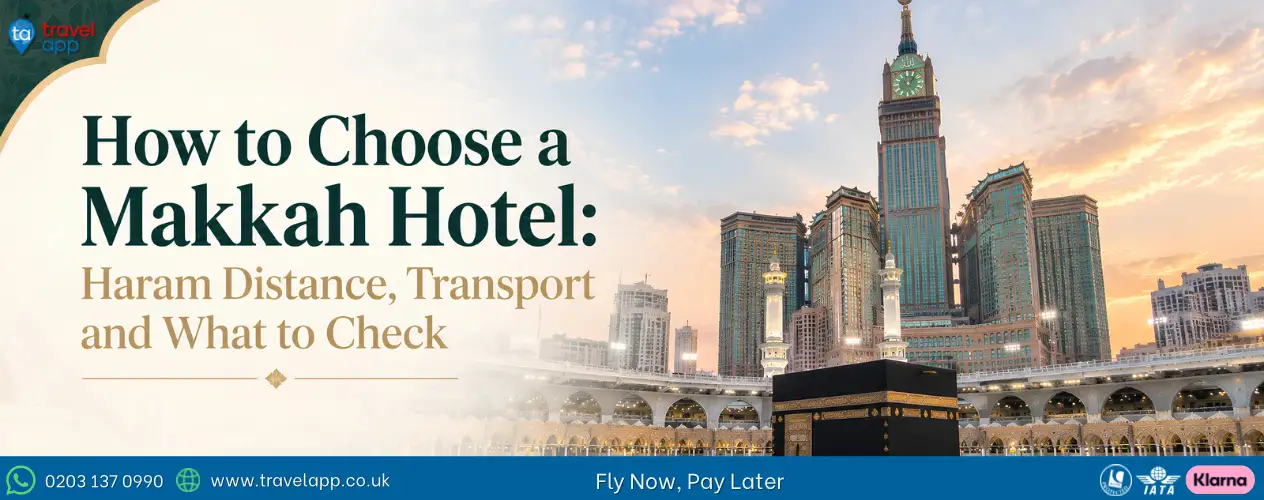
The closest hotel to the Haram is not automatically the best choice. A hotel a few hundred metres away can involve more walking, stairs and lift queues than a hotel further out with a smooth, reliable shuttle. Choosing well means weighing distance against transport, accessibility, room configuration and price together, rather than picking on distance alone.
This guide explains how Makkah's main hotel areas relate to Masjid al-Haram, what "close to Haram" really means once lifts, gates and crowds are taken into account, how hotel shuttles work in practice, and what to check before you book.
It is designed for first-time pilgrims, families, elderly travellers and anyone trying to balance convenience with budget.
If you have not yet sorted your entry requirements, our Saudi Arabia ETA guide is worth reading alongside this one.
A hotel's advertised distance from the Haram is rarely the same as the distance you will actually walk.
Many booking sites calculate distance as a straight line on a map rather than the route a pedestrian follows. A hotel listed as "300 metres from Haram" may involve a longer walk once you account for the hotel's entrance, the available pedestrian route and which Haram gate you use.
A better way to judge closeness is to consider the whole journey:
Straight-line versus walking distance. A map measures as the crow flies. Roads, buildings and pedestrian routes can make the actual walk longer.
Hotel entrance, lifts and lift queues. Reaching street level from a high floor can take several minutes during busy periods, especially in a large tower.
The route itself. Is it flat or sloped? Covered or exposed to the sun? How many roads does it cross? Which Haram gate does it lead to?
Terrain and the return journey. A route that feels manageable on the way to the Haram can feel much harder on the way back, especially if it includes an incline.
Crowds and timing. The same route can take much longer during Ramadan, peak prayer periods and other busy times.
This matters most for elderly pilgrims, wheelchair users, families with young children and anyone with limited mobility. For them, an extra slope, lift wait or road crossing can matter more than a few hundred metres on a map.
A hotel that is further away but has a simple route, good lift access and reliable transport can therefore be a better choice than one that looks closer on paper.
Treat any specific distance or walking-time figure in this guide as indicative rather than guaranteed. To understand the practical journey for a particular hotel, check its exact address, look at the pedestrian route on a map and ask the hotel which Haram access point is most practical from its entrance.
Makkah hotels can broadly be grouped into three practical zones based on how pilgrims reach the Haram: hotels where walking is usually the easiest option, areas where walking is possible but more variable, and locations where pilgrims generally depend on a shuttle or taxi.
Prices often increase with proximity, but distance is only one part of the decision. Walking difficulty, room quality, accessibility, food and the total cost across your stay all matter.
This zone covers the Abraj Al Bait (Clock Tower) complex and Jabal Omar, two developments close to the Haram.
The Clock Tower complex includes several well-known hotel brands connected to the mosque by covered walkways. Jabal Omar also contains major hotels close to the Haram, although the exact access route varies between properties.
These hotels generally command the highest prices in Makkah, particularly during Ramadan and Hajj, when demand is high. Our best time to go for Umrah guide explains how the time of year can affect availability, crowds and prices.
Convenience still varies by hotel, floor and entrance. A high floor in a large tower can mean a longer lift wait than a lower floor in a smaller building. Being close to the mosque does not automatically mean every part of the hotel is equally convenient.
This zone is particularly suited to elderly pilgrims, travellers with limited mobility and anyone who prioritises minimal walking, as well as shorter stays where the higher nightly rate is easier to justify.
This zone includes Ajyad, Ibrahim Al Khalil Road and parts of Misfalah, generally south of the Haram.
These areas can offer a walkable route, but the terrain varies. Parts of Ajyad and Ibrahim Al Khalil Road include steep sections, and the uphill return after prayer can matter more than the outbound distance suggests.
Misfalah is a larger, mixed district. Individual hotels can differ significantly in their actual location and accessibility.
Do not assume every hotel described as "Misfalah" or "Ajyad" offers the same access. These are broad district names covering properties at different distances from the Haram.
Prices are generally lower than in Zone 1. This zone can suit budget-conscious and solo pilgrims who are comfortable walking, particularly on longer stays where saving money across several nights makes a meaningful difference.
This zone includes Aziziyah, Mahbas Al Jin and Kudai. Hotels in these areas are generally more dependent on shuttle transport or taxis than the central Haram districts, although the actual distance varies significantly by hotel.
These locations are not necessarily a poor choice. Rooms can offer better value and, depending on the property, more space for families or longer stays.
The trade-off is greater dependence on transport. That makes the specific hotel's shuttle arrangements much more important than the district name alone.
Do not assume a hotel offers a shuttle simply because it is in Aziziyah, Kudai or Mahbas Al Jin. A shuttle is a service offered by an individual hotel, not something guaranteed by the district. Some hotels provide regular services, while others may offer limited transport or none at all.
Always confirm shuttle provision with the specific hotel before booking.
Hotel location is only one part of the journey. Your flight arrival time, airport transfer, transport between Makkah and Madinah and the practical route to the Haram can all affect how manageable your Umrah feels. When comparing Umrah packages, look at the whole journey rather than choosing accommodation on price alone. TravelApp UK can help you compare these details as part of your package.
A hotel a kilometre away with a reliable shuttle can be a better choice than a hotel 500 metres away with a difficult walk.
A short walk on paper can still involve a steep return journey, road crossings, lift queues and crowded areas around prayer times.
A longer journey by an air-conditioned shuttle followed by a short, manageable walk can be considerably easier, particularly for elderly pilgrims, young children or anyone with limited mobility.
Neither option is automatically better. It depends on how much walking you can comfortably manage and how reliable the specific hotel's transport is.
Road restrictions and traffic-management arrangements around the Haram can affect shuttle routes and journey times, particularly around busy prayer periods.
Do not assume that a shuttle advertised as "24/7" means a bus departs continuously throughout the day.
"24-hour shuttle" can describe the availability of a service rather than a vehicle departing continuously. Ask the hotel how frequently it operates and what happens during busy prayer periods.
Before you book, ask the hotel directly, preferably in writing:
Is the shuttle complimentary, or is there a charge?
What are its actual operating hours?
Does it operate before and after all five daily prayers, or only at certain times?
Are there periods when the service is suspended because of traffic restrictions?
How frequently does it run?
Is frequency reduced during particularly busy periods?
Exactly where does it drop passengers?
How far is the drop-off point from a Haram entrance?
Where is the return pickup point?
Is the pickup point clearly marked?
Does the service continue during Ramadan?
Does it operate during Hajj, if relevant to your dates?
Is there a backup transport option if the shuttle is full or suspended?
Is the vehicle wheelchair accessible?
How many passengers does each vehicle carry?
How long is the typical wait during peak periods?
If your package includes travel between Makkah and Madinah, transport is another detail worth checking before you book. Our guide to travelling from Makkah to Madinah explains the main transport options and what to consider.
For pilgrims considering the train, our Haramain High-Speed Railway guide covers the journey between the two holy cities.
Haram view does not necessarily mean Kaaba view.
Not every room in a hotel marketed as having a "Haram view" offers the same outlook. Hotels around the mosque can have several room categories, with the view depending on the room position, floor and category.
For example, Mövenpick Hotel Makkah and Swissôtel Makkah publish separate room categories for partial and full Haram views.
A "Haram view" room may show part of the mosque, courtyard, domes or surrounding structures without providing a clear view of the Kaaba itself. Even rooms within the same category can differ depending on their position in the building.
Before paying a premium for a view, ask:
Which exact room category is being offered?
What floor is the room on?
Is the Kaaba itself visible, or is it a wider Haram or courtyard view?
Is the view full or partial?
Is the view guaranteed for the room category you are booking?
Is the price premium specifically for the view?
Can the hotel provide a recent image from the relevant room category?
A Haram-facing view can add significantly to the cost of a stay, so be clear about what you are actually paying for.
Beyond the zone and shuttle questions above, run through these practical checks for any hotel, regardless of price or location.
The official Nusuk platform is also worth checking for broader pilgrimage planning alongside your hotel research.
Hotels advertise rooms by maximum occupancy, such as "quad room" or "family room", but the actual sleeping arrangement can vary.
A quad room does not necessarily mean four standard beds. It may contain two or three beds plus a sofa bed, or an additional rollaway bed.
Before booking, confirm:
The exact number and type of beds
Whether additional sleeping space is a proper bed, sofa bed or rollaway
Whether a cot is available if required
Whether the room comfortably suits everyone travelling
Whether the arrangement works for elderly parents or young children
The number of lifts relative to the size of a hotel can affect waiting times, especially around busy prayer periods.
Ask how many lifts serve your floor and whether the hotel experiences particularly long waits at peak times.
This is highly hotel-specific. A larger or more famous tower does not automatically have better lift access than a smaller property.
For wheelchair users or anyone with limited mobility, check:
Whether the entrance is step-free
Whether accessible rooms are genuinely available
Whether accessible bathrooms have the features you need
Whether the hotel's shuttle vehicle is wheelchair accessible
How far an accessible room is from the lift
How far the room is from dining facilities
Do not rely on a generic "accessible" label. Ask the hotel what accessibility actually means for the room and route you are booking.
Check exactly what is included: breakfast only, half board or full board.
During Ramadan, meal timings can change around fasting hours, so ask the hotel how meals are organised during your dates.
It is also useful to check for nearby food courts, supermarkets or affordable restaurants if you expect to eat outside the hotel's meal plan.
Food matters, but it should not be the only factor deciding where you stay.
Also check:
Wi-Fi reliability
Air conditioning
Housekeeping
Luggage storage before check-in and after check-out
Prayer facilities on site
Laundry service for longer stays
Nearby pharmacy and supermarket
Family room policies
Age restrictions for children sharing rooms
Cancellation terms
Deposit requirements
Whether the quoted price includes all taxes and fees
Be cautious of listings or agents using vague claims such as "near Haram", "Haram view", "walking distance" or "free shuttle" without providing specific details.
GOV.UK's Saudi Arabia travel advice also advises pilgrims to use reputable and verifiable booking channels.
Before paying, verify:
The exact hotel name and address, using the hotel's own website and an independent map
Recent guest reviews from more than one platform
The specific room type rather than relying on a generic photograph
The cancellation policy in writing
Any shuttle arrangement directly with the hotel
The claimed distance using a map yourself
Whether taxes and fees are included in the quoted price
One simple precaution is to request a written booking confirmation containing the exact hotel and room details, along with the hotel's own booking reference where available.
Keep this confirmation with the rest of your travel documents checklist, and check the hotel independently before travelling.
No single price tier is right for every pilgrim. The difference between tiers can also become much larger during Ramadan Umrah packages and Hajj, when demand is particularly high.
Budget: Best for pilgrims where price is the main consideration and who are comfortable relying on a shuttle, particularly on longer stays where nightly savings can add up. Trade-offs can include greater distance, smaller rooms and more time spent travelling. Many budget-conscious UK pilgrims booking from the capital compare options through our Umrah packages from London.
Mid-range: A practical choice for families and pilgrims looking for a balance between Haram access, room quality and price. Our Umrah packages from Birmingham can be a useful comparison point for family-sized groups travelling together.
Luxury: Often best suited to elderly pilgrims prioritising minimal walking, shorter stays where convenience matters most, and travellers who place a high value on premium facilities or a genuine Haram-facing room. A higher price does not automatically make a hotel better. It makes sense when convenience and facilities matter more than saving on the room rate. See our Umrah packages from Manchester for an example of how premium options can be positioned.
If you are comparing complete packages rather than hotels alone, our Umrah packages from the UK guide explains what is usually included and what to check before booking.
| Zone | Typical Access Pattern | Transport | Best Suited For |
| Zone 1: Clock Tower / Jabal Omar | Short walk, often via covered walkways; tall towers can still involve lift queues | Usually walkable; shuttle rarely needed | Elderly pilgrims who prioritise minimal walking, short stays and convenience |
| Zone 2: Ajyad / Ibrahim Al Khalil / Misfalah | Walkable for many hotels, but varies by property and can include steep or uphill sections | Walkable for many, although some Misfalah hotels are more transport-dependent | Budget-conscious and solo pilgrims comfortable walking, longer stays |
| Zone 3: Aziziyah / Mahbas Al Jin / Kudai | Generally more dependent on transport than central Haram areas | Shuttle, public bus or taxi, depending on the property | Families needing space, value-focused travellers and longer stays |
Treat the "typical access pattern" as a general guide rather than a fixed distance. Always check the exact hotel's route and transport arrangements before booking.
Travelling with elderly parents: prioritise minimal walking, confirmed lift access, step-free routes, reliable transport and easy access to dining rather than focusing on a marginally shorter advertised distance.
Travelling with young children: prioritise a genuine family room configuration, straightforward food options, working lifts and a route the whole family can manage without exhausting younger travellers.
Tight budget: prioritise a genuinely reliable shuttle over a slightly cheaper room if poor transport would make the stay more difficult. Compare the total cost across your stay, including food and transport, rather than looking at the nightly room rate alone.
First Umrah: prioritise simplicity. A clear route, straightforward transport and responsive hotel support can be more useful than the lowest price or most impressive-sounding location. Our how to perform Umrah guide is a useful companion once your hotel is settled.
Luxury experience: prioritise the exact room category, view and facilities you are paying for, and verify them directly with the hotel rather than relying only on marketing language.
Need help choosing the right Umrah package?
If you're unsure which hotel, transport option or package setup will work best for your trip, TravelApp UK can help you compare the practical details alongside the price. You can explore Umrah packages with flights, accommodation, transport and visa support, depending on the package you choose.
Whichever zone or budget you are considering, the same basic checks apply: confirm the exact hotel name, room category, location, transport arrangements, meal plan, accessibility features and cancellation terms before paying.
For elderly parents or anyone with limited mobility, give particular attention to the actual walking route, lift access and transport arrangements rather than relying on an advertised distance alone.
It is also worth checking your wider travel costs. A cheaper hotel may not be cheaper overall if you need frequent taxis or spend more on meals and transport.
If you are still comparing complete packages, our Umrah packages from the UK guide can help you understand what is normally included.
If you would rather talk through your options, our team can help you compare hotel locations, transport and room configurations as part of an Umrah package from the UK.
Quick answers to common questions. Reach out if you need more help.
Neither is automatically better. It depends on your mobility, budget and the reliability of the specific shuttle. A closer hotel reduces your dependence on transport but can still involve real walking, slopes and lift queues. A shuttle-dependent hotel further out can be more comfortable overall if the service is frequent and reliable, and it will often cost less.
There is no single best area for every pilgrim. Clock Tower and Jabal Omar suit those prioritising minimal walking and willing to pay more. Ajyad, Ibrahim Al Khalil and parts of Misfalah can suit budget-conscious pilgrims who are comfortable walking and managing slopes. Aziziyah, Mahbas Al Jin and Kudai can suit families and value-focused travellers who are comfortable relying on transport.
This varies by hotel, season and traffic conditions, so it should never be assumed. Traffic restrictions around the Haram can affect shuttle routes and journey times around busy prayer periods. If shuttle access is important to you, ask the specific hotel for its current operating arrangements rather than relying on a general "24/7" claim.
Confirm the exact hotel name and address independently, check recent reviews and verify any shuttle claim directly with the hotel. You should also confirm the actual room configuration and bed types, cancellation policy, accessibility arrangements and whether taxes and fees are included in the quoted price.
There is no fixed ideal distance. The same advertised distance can involve very different journeys depending on terrain, gate access, hotel entrances and crowd levels. Focus on the practical walking route and your own mobility rather than choosing a hotel based on a specific number of metres.
Hotels in areas further from the Haram, including parts of Aziziyah, Mahbas Al Jin and Kudai, are generally more affordable than properties in the closest central areas. Exact prices vary significantly by hotel, season, room type and booking date.
This depends entirely on the individual hotel. Some include shuttle transport in the room rate, while others may charge separately or offer a limited complimentary service. Confirm the arrangement directly with the hotel before booking.
Ajyad can work well for pilgrims who are comfortable with walking and slopes, and it is generally more affordable than the closest Haram areas. It may be less suitable for pilgrims who struggle with inclines, as some parts of the district have steeper sections.
That depends on how much the view matters to you personally. It is a premium rather than a necessity. If you choose to pay for it, confirm the exact room category, floor and whether the Kaaba itself is visible. Do not assume that every room marketed as "Haram view" provides the same outlook.




